


The world of online casinos can seem simple on the surface; after all, you’re the house, so how could you lose? In reality, the business is far more complex than it appears. With gambling laws constantly changing across the world, operators are forced to adapt quickly. In many cases, that adaptation means pushing or outright crossing legal and ethical boundaries.
After more than a decade in the gambling industry, I’ve seen many of the tactics operators use behind the scenes, and in this article, I’m going to break down how they work. Keep in mind that this article should act as a cautionary tale for players on what red flags to avoid.
Understanding Gambling Laws for Offshore Casinos
Gambling laws differ a lot depending on the country, which is why there are different types of offshore iGaming markets. In the marketing world, these are referred to as Grey and Black markets.
Grey market
Grey markets are typically countries where offshore gambling is technically restricted or unlicensed, but enforcement is inconsistent or limited. As a result, many operators continue to market their services to players in these regions despite lacking a local license.
Finland is often cited as an example of this type of market. While Finland has long operated under a state monopoly system, many offshore casinos, including those licensed in jurisdictions such as Anjouan or Curacao, have continued accepting Finnish players.
Black market
Black markets are the most extreme side of online gambling. These are countries where offshore gambling is clearly illegal, heavily enforced, and actively targeted by regulators. Typical measures include ISP blocks nationwide, fines, payment restrictions, and, in some cases, sanctions.
Spain is typically seen as a black market when it comes to offshore casinos not holding their local license, with their Directorate General for Gambling Regulation (DGOJ) constantly dealing out heavy fines, blocking domains, and fining different payment providers the operators use.
Offshore Licenses: The Legal Shield Behind Many Online Casinos
Many online casinos operate in a legal gray area by obtaining offshore gambling licenses rather than licenses from the countries where their players are located.
Curacao became one of those popular jurisdictions for online casinos due to its relatively low licensing costs and ability to serve many international markets. Curaçao has introducted major licensing reforms in 2024 and 2025, but the jurisdiction remains a major hub for offshore gambling operators.
Anjouan is the fastest growing licensing jurisdiction. Their licensing costs are even lower, around $30k inclduing lawyer fees, and only takes three weeks to receive. Critics argue that these offshore licensing systems provide casinos with a little stamp of legitimacy, while making the enforcement of regulators much harder.
Many casinos licensed in Curaçao or Anjouan implement responsible gambling tools, KYC procedures, anti-money laundering controls, and geo-restrictions for jurisdictions where they are not permitted to operate. At Bonus Dealers, we have reviewed numerous Curaçao- and Anjouan-licensed casinos that provide a safe and professional user experience. While offshore licenses are often viewed as less stringent than licenses issued by regulators such as the Malta Gaming Authority (MGA) or the UK Gambling Commission (UKGC), the quality of individual operators can vary significantly, and some offshore casinos maintain standards comparable to those found in more heavily regulated markets.
Now that we have that cleared up, let’s go into the more interesting stuff.
Domain mirrors
Domain mirrors are basically duplicate versions of the same site, just under a different domain name. These mirrors often run on the same backend and database, but operate under different domain names. When one domain gets taken down by a regulator, operators quickly redirect users to a new one.
The trick most illegal operators use is having the main domain (let’s say DealersCasino.com) check if the user is from a restricted country, then redirect to a mirror (DealersCasino1.com). This allows them to keep their valuable main domain and constantly redirect new users to new domains.
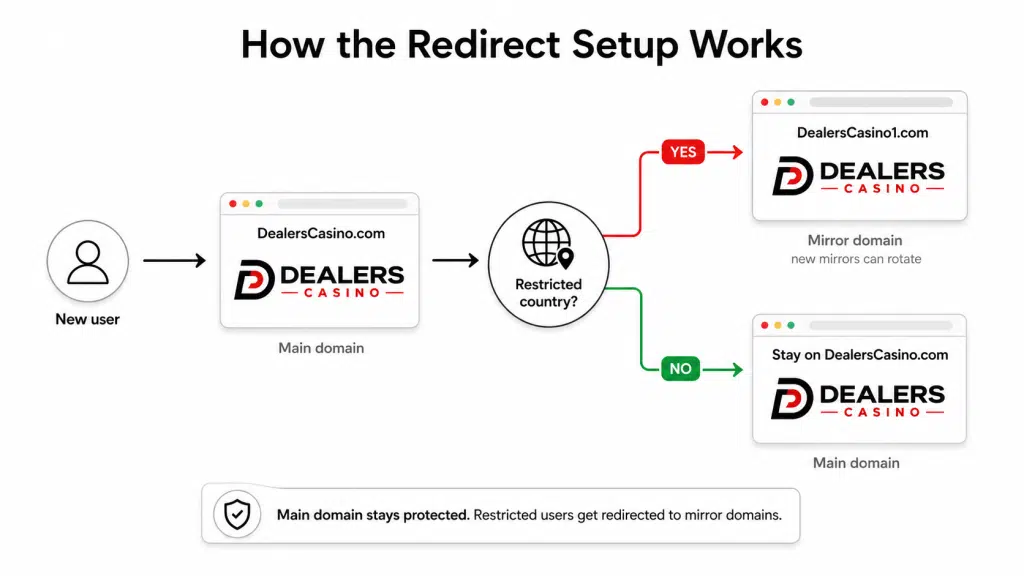
When a casino receives its license, the license applies to the exact approved domain, not the brand as a whole. This means that any mirror site actively facilitating gambling operates outside the regulator’s approval and is therefore breaking the rules, meaning the mirror may be operating outside of the approved license and regulations.
How Do They Accept Payments?
Payments are the most complex part of these illegal casino operations, with PSPs (Payment Service Providers) often having issues due to sanctions, fines, ISP blockings, etc. That’s where payment orchestrators come in. A payment orchestrator is a service provider that doesn’t handle payments; they just route paying players through different PSPs depending on payment method, IP, location, time of day, and more. If one payment method fails, they just route to the next. The most popular Payment orchestrators include PaymentIQ and Praxis.
The more sophisticated online casinos might have 30 different PSPs that just change when one gets taken down. These PSPs are not your normal ones, such as Stripe or PayPal. One popular PSP as of 2026 is Rillpay rail that allows users to deposit using their local bank.
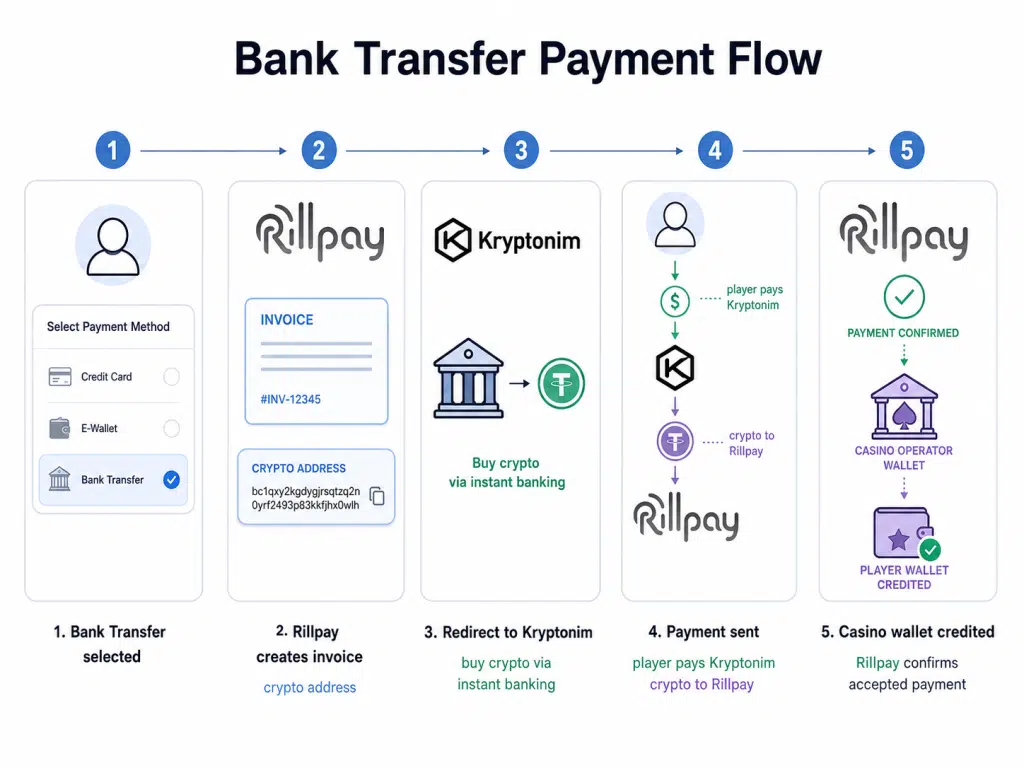
The payment flow works as follows:
- Player picks Bank Transfer as their Payment Method
- Player is redirected to Rillpay, which creates an invoice with a crypto address to receive the payment
- The player then gets redirected to Kryptonim, a Polish company made for buying crypto with instant banking
- Player pays Kryptonim, and Kryptonim sends crypto to Rillpay
- Rillpay tells the casino operator that the payment has been accepted, and credits the player’s casino wallet
What really happens is that the player buys crypto and sends it to Rillpay, not depositing it into a casino using their bank. Banks actively try to avoid being associated with offshore online casinos, which is why the payment flow works like this.
How Do They Get Players?
The number one way these illegal online casinos get players is through affiliates. Affiliates are the backbone of every one of these operations, where affiliates can get up to 50% revenue share or up to $300 per player making their first deposit, making it very lucrative. The main way these affiliates get traffic is through media buying, more specifically Meta Ads on Instagram and Facebook.
These ads are often deceptive, promising fake bonuses to get players to deposit. The ad accounts these affiliates use are often burner accounts, created to promote niches not allowed on Meta. They might have 20-30 accounts in rotation just waiting to get banned.

The most valuable traffic for illegal online casinos usually does not come from Meta ads. It comes from Google’s organic search results. One common affiliate tactic is to target high-intent keywords aimed at vulnerable players, including people who have self-excluded from licensed gambling sites. These keywords include “casinos not on GamStop” and “casinos zonder CRUKS”. GamStop is the UK’s self-exclusion scheme that lets players block themselves from accessing online gambling sites with a license in the UK, and CRUKS is the same thing but in the Netherlands. Players who have self-excluded might feel tempted to search for a way around these restrictions, especially at moments of relapse or financial problems. That makes these keywords extremely valuable to affiliates and to the operators.
Google is actively trying to restrict affiliates from ranking for these keywords, but they often find their way through using blackhat SEO methods, such as using expired domains to fake authority
Red flags players can check before depositing
We have made a list of red flags to look out for before making a deposit.
- Domain Mirror: If the casino redirects you to a domain with a number or slight variation, such as DealersCasino1.com instead of DealersCasino.com, that is a major red flag.
- Hiding their license: The license of your chosen online casino shouldn’t be hidden; it should be visible on the main page and link to the proper regulator
- The casino targets self-excluded players: Keywords like “casinos not on GamStop” are serious red flags. These keywords are designed to attract people who have taken steps to stop themselves from gambling.
- Weird payment flows: Are you being redirected countless times after trying to pay? You probably won’t know where your money goes. Players should know exactly who receives their money, which company processes the payment, and if the transaction is a crypto payment or a gambling deposit.
- Misleading bonuses: Affiliates and operators use misleading bonuses to get players to deposit. It might say “Get $300 on signup”, but in reality, you’re just getting $300 if you deposit the same amount. Bonus terms for these shady sites are often horrible, often requiring you to wager 40-50x of the bonus amount before you can withdraw.
- Withdrawal rules are vague and unfair: These shady sites will try their hardest not to give you your winnings. This includes having impossible withdrawal requirements, such as a minimum withdrawal of $1,000. Verification is another thing these guys love to complicate, often requiring ID, proof of residence, and proof of income just to make the player not want to bother.
- Bad player review score: Always check sources such as TrustPilot or AskGamblers to see what other players say. Casino affiliates will say anything to make players deposit, so make sure you get the information from a trusted site.
These are also the same warning signs we look for when reviewing crypto casinos. A big bonus or fast-looking signup process does not mean much if the license is unclear, the domain does not match, the payment flow is confusing, or players are being targeted through self-exclusion keywords. Our full review process goes deeper into this, which you can read in our How We Rate guide.
Conclusion
The business of operating illegal online casinos is as big as ever, and it is constantly evolving. These operators are not just putting up random casino sites and hoping for the best. The more sophisticated ones are building entire systems around mirror domains, payment routing, aggressive affiliates, and blackhat SEO to keep taking players even after regulators try to shut them down.
What often separates one illegal operator from another is not the casino product itself, but how creative they are at avoiding enforcement. Some use endless domain mirrors. Others hide behind payment flows that make a gambling deposit look like a crypto purchase. Some rely on affiliates targeting vulnerable players who have already self-excluded.
For players, the main lesson is simple: do not judge a casino only by its bonus, design, or game selection. Check the license, check the domain, read the withdrawal terms, and pay attention to how the payment actually works. If a casino is redirecting you through mirrors, hiding its company details, or targeting players looking for ways around self-exclusion, that is not a small red flag.
If you come across online casinos using these tactics, report them to the proper authorities in your country. In recent years, regulators in markets such as Spain and the Netherlands have taken a much harder stance against illegal operators, including issuing heavy fines, blocking domains, and going after the companies that help these casinos process payments.
Illegal casinos survive because they move fast, but they also rely on players not knowing what to look for. The more transparent this industry becomes, the harder it gets for these operators to hide.